
How to Source Real Liposomal Vitamin C?
Avoid costly liposomal vitamin C sourcing mistakes. Learn the 3 non-negotiable quality metrics and practical testing methods to avoid supplier scams and ensure product performance.
MARKET TRENDS & INGREDIENTS
5/13/20265 min read
1. The Experience of Ingredients Sourcing
Over the past 5 years, I’ve spent half of every single day vetting and qualifying raw material suppliers. Even for a simple formulation or a common ingredient like vitamin C, I routinely compare more than 10 vendors side-by-side.
And even when multiple suppliers source from the same factory, there are critical differences in production dates, whether the original factory packaging has been opened, and variations between production facilities—even those owned by the same large-scale manufacturer.
My number one rule for ingredient sourcing, learned through years of costly mistakes, is this: Never fully trust a supplier-provided certificate of analysis (COA).
That doesn’t mean COAs are useless. A well-written COA will tell you exactly what production metrics a manufacturer actually controls.
A COA with more tests isn’t necessarily better—what matters is whether the tests measure the parameters that actually impact how the ingredient performs in your final product.
For liposomal vitamin C, there are three non-negotiable quality metrics that you must verify independently. Failing to do so can lead to consumer complaints, regulatory enforcement actions, and permanent damage to your brand reputation.
These three metrics are the only scientifically validated criteria that separate authentic liposomal vitamin C from cheap imitations. They directly determine absorption efficiency, shelf stability, and product performance—and you cannot skip any of them.
2. The 3 Core Metrics That Define Real Liposomal Vitamin C
① Encapsulation Efficiency
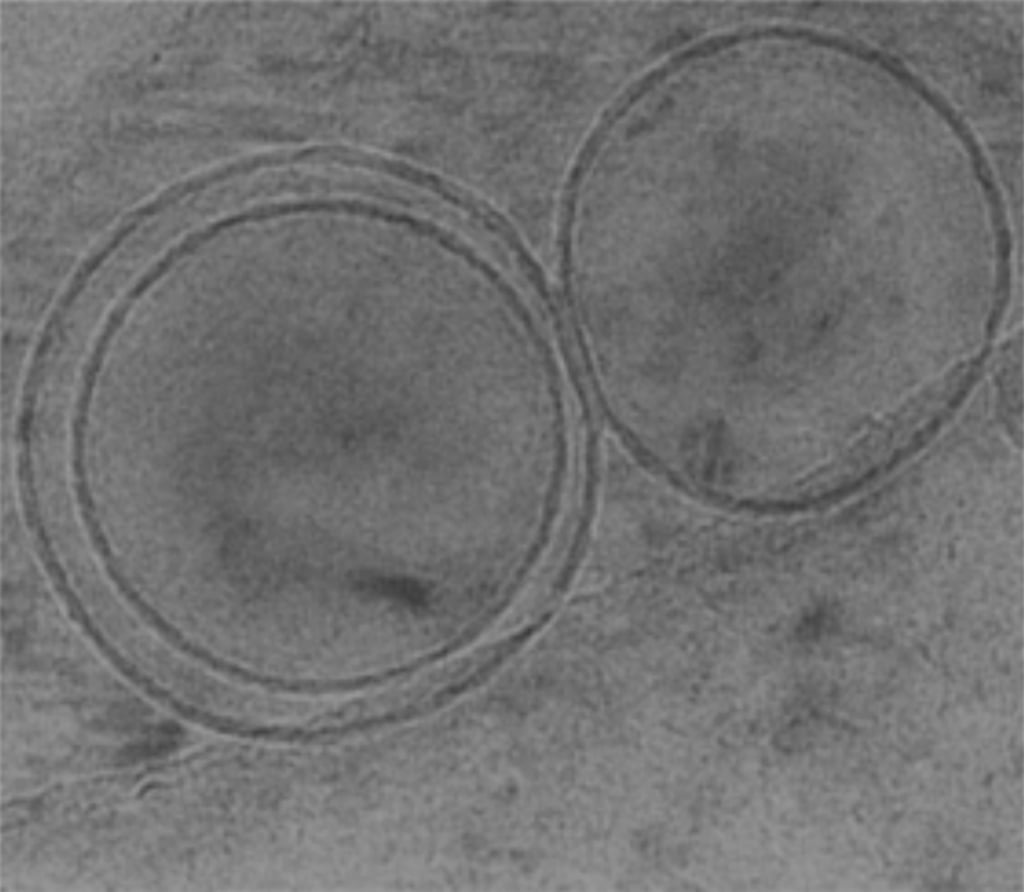
Definition: The percentage of total vitamin C that is successfully enclosed within the phospholipid bilayer, rather than floating free in solution.
Why it matters:
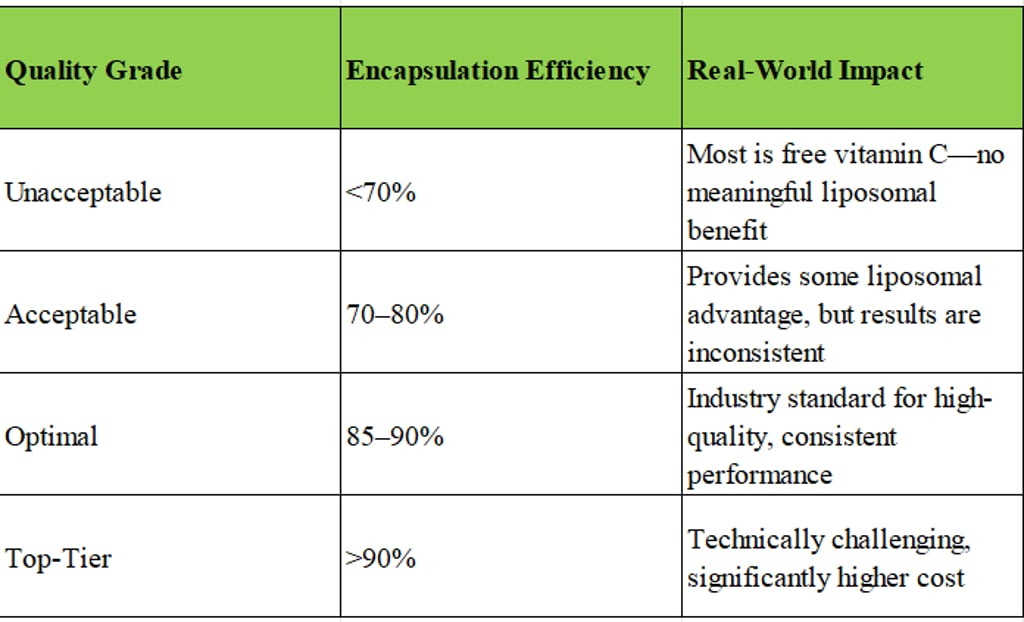
Directly impacts gastrointestinal tolerance: When <70% encapsulated, more than 30% free vitamin C will irritate the stomach lining, causing acid reflux and diarrhea
Determines bioavailability: Only encapsulated vitamin C can bypass the SVCT transporter saturation limit
Ensures clinical consistency: Batch-to-batch fluctuations greater than 10% can result in a 2x difference in absorption efficiency
② Mean Particle Size (Z-Average)
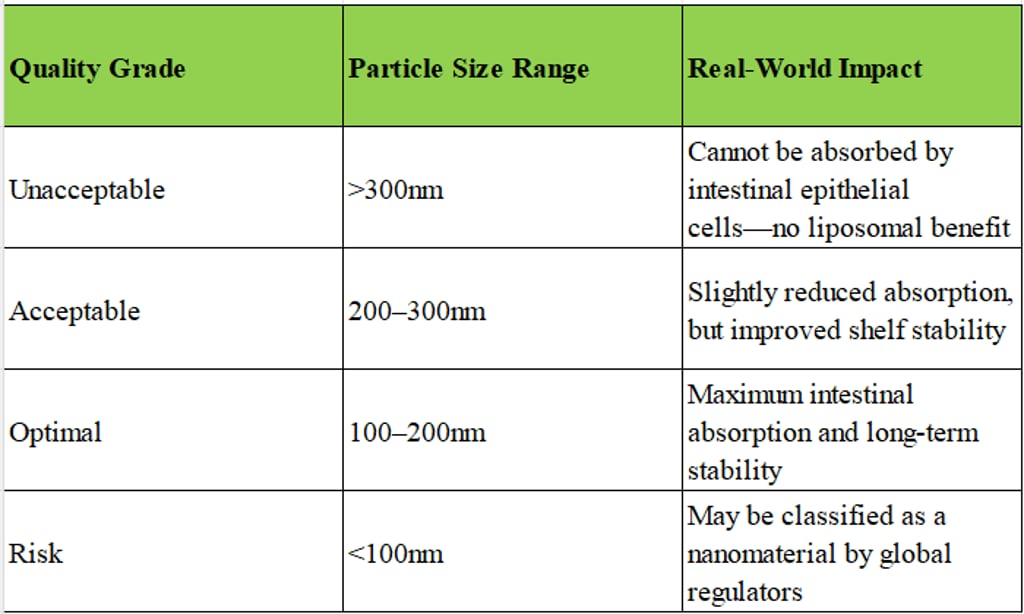
Definition: The intensity-weighted average diameter of liposomal particles, measured by dynamic light scattering.
Why it matters:
Only particles between 100–200nm can be absorbed via endocytosis and membrane fusion
Particles larger than 300nm cannot cross the intestinal barrier
Particles smaller than 100nm may trigger strict nanomaterial regulations (see our global regulatory guide for details)
③Polydispersity Index (PDI)
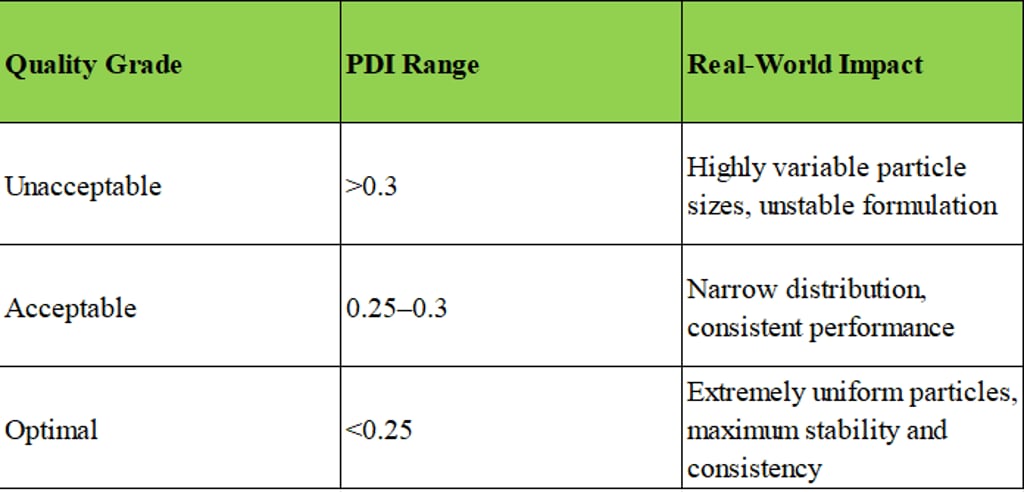
Definition: A numerical measure of how uniform the particle size distribution is in a formulation.
Why it matters:
Determines shelf stability: PDI >0.25 leads to rapid particle aggregation and encapsulation loss during storage
Ensures batch-to-batch consistency: PDI fluctuations greater than 0.1 indicate an unstable manufacturing process
3. Practical Verification Methods
You can perform these tests in your own facility to quickly identify low-quality products:
① Freeze-Thaw Stability Test:
Freeze a sample at -20°C for 24 hours
Thaw completely at room temperature
Repeat 3 times
✅ Pass: No separation, no precipitation, <10% change in particle size/encapsulation
❌ Fail: Visible layering, white sediment, complete loss of liposomal structure
② Centrifugation Test:
Centrifuge a sample at 3000 rpm for 30 minutes
✅ Pass: No obvious visible sediment at the bottom
❌ Fail: Significant white precipitate (free vitamin C crystals)
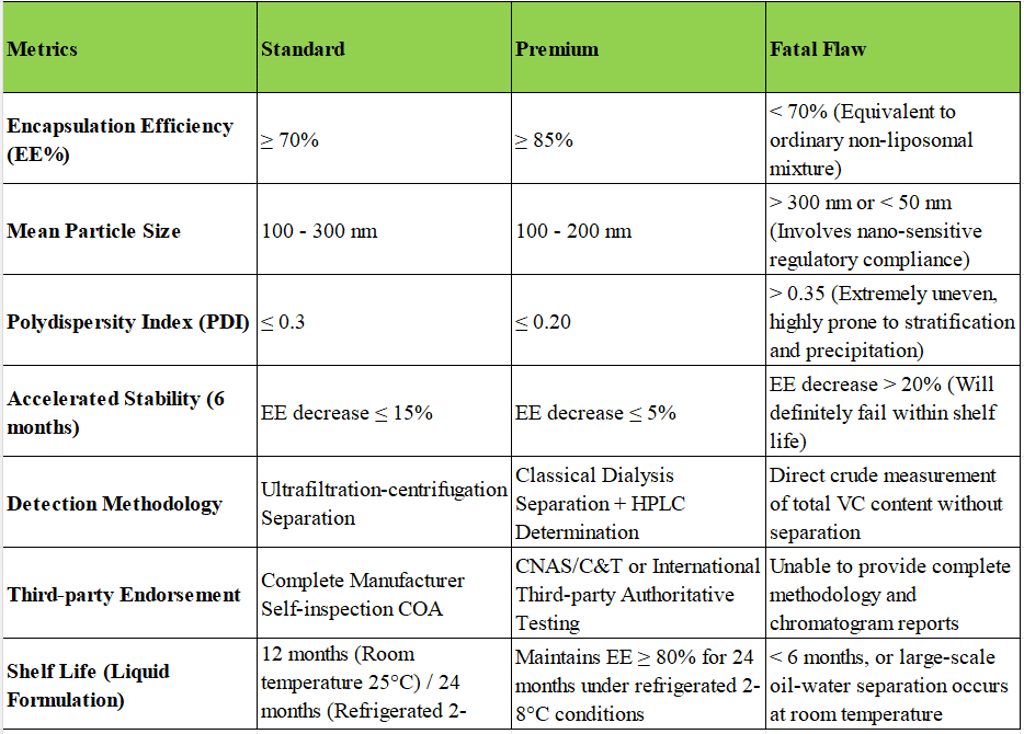
4. Liposomal Vitamin C Sourcing Decision Checklist
If any one of these metrics is substandard, the product offers no advantage over regular vitamin C.
Never make sourcing decisions based solely on price. High-quality liposomal vitamin C costs 3–5 times more than regular ascorbic acid.
If a supplier’s quote is significantly lower than this, there is definitely a quality issue.
Always purchase small sample quantities first and send them to an independent third-party laboratory for verification before placing a large order.
5. Are you ready to build your product?
Option 1: Let Us Handle Your Ingredients Sourcing & Formulation Development
Skip the time-consuming and risky supplier vetting process. Vantage BioGenesis provides comprehensive CRO+Independent production oversight services for supplement brands, including:
Full ingredients source verification
Independent third-party testing oversight
Bulk ingredient procurement and inventory management
Independent production oversight (verification of each batch of products through third-party testing, from ingredients procurement to product release).
If you already have a preferred ingredient supplier, we can also evaluate their COAs and samples to ensure they meet quality standards for the final product.
➡️ Let‘s Start with Feasibility Analysis
Option 2: Choose the Right Dosage Form
Not all dosage forms are suitable for liposomal vitamin C. Liquids, powders, tablets, gummies, and soft capsules all have different stresses on the phospholipid bilayer and different system stability, and consumers' usage scenarios and consumption habits also vary.
about Market Trends & Ingredients
FAQ (How to Source Real Liposomal Vitamin C)
❓ What is the number one rule for sourcing liposomal vitamin C ingredients?
A: Never fully trust a supplier-provided certificate of analysis (COA). While COAs are useful for identifying controlled production metrics, they must be independently verified to ensure accuracy.
❓ What are the 3 core metrics that define real liposomal vitamin C?
A: The only scientifically validated criteria are encapsulation efficiency, mean particle size (Z-average), and polydispersity index (PDI). These directly determine absorption efficiency, shelf stability, and product performance.
❓ What is a good encapsulation efficiency for liposomal vitamin C?
A: Premium quality liposomal vitamin C should have 85–90% encapsulation efficiency. Anything below 70% is unacceptable, as most will be free vitamin C with no liposomal benefit.
❓ What is the optimal particle size for liposomal vitamin C?
A: The golden range is 100–200nm, which balances maximum intestinal absorption and regulatory compliance. Sizes above 300nm cannot be absorbed, while sizes below 100nm may be classified as nanomaterials.
❓ What is PDI and why is it important for liposomal vitamin C?
A: PDI (Polydispersity Index) measures particle size uniformity. A pharmaceutical-grade PDI <0.25 ensures maximum shelf stability and consistent batch-to-batch quality. PDI >0.3 indicates an unstable formulation.
❓ How can I test liposomal vitamin C quality in my own facility?
A: Two simple tests: 1) Freeze-thaw test (3 cycles at -20°C/room temperature) – no separation or precipitation indicates good quality; 2) Centrifugation test (3000 rpm for 30 minutes) – no visible sediment indicates good quality.
❓ What are common supplier scams to avoid when buying liposomal vitamin C?
A: Avoid claims of 99% encapsulation efficiency (industrial maximum is ~92%), suppliers who only provide particle size without PDI, products that claim no refrigeration is needed, and "liposomal blends" that are just physical mixtures.
❓ How much does high-quality liposomal vitamin C cost compared to regular vitamin C?
A: High-quality liposomal vitamin C costs 3–5 times more than regular ascorbic acid. If a supplier’s quote is significantly lower than this, there is almost certainly a quality issue.
❓ What is the most important step before placing a large liposomal vitamin C order?
A: Always purchase small sample quantities first and send them to an independent third-party laboratory for verification of encapsulation efficiency, particle size, and PDI.