Global Market Entry: Regulatory & Labeling Guide for Liposomal Vitamin C (USA, EU, & China)
2026 updated global regulatory guide for liposomal vitamin C. Master FDA (USA), EFSA (EU) and SAMR (China) compliance, labeling rules and market entry strategies.
MARKET TRENDS & INGREDIENTS
4/25/20265 min read
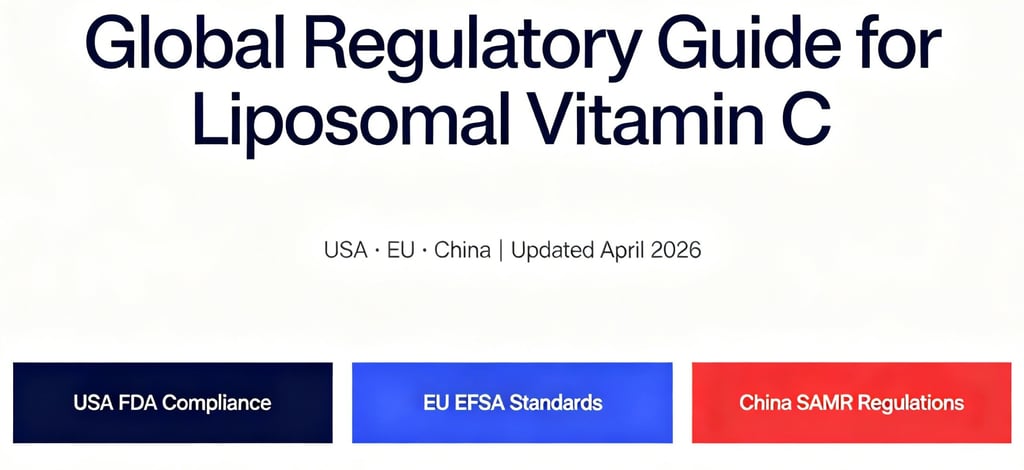
Liposomal vitamin C is one of the fastest-growing premium supplement ingredients on the market today. Global sales are projected to exceed $1.2 billion by 2028, growing at a compound annual growth rate (CAGR) of 12.3%.
However, for brand owners, launching a Liposomal Vitamin C product globally involves navigating a complex web of international regulations. Especially for serious supplement brands, compliance is not an afterthought—it is the foundation of a sustainable business.
As a leading CRO and production oversight partner, Vantage BioGenesis has synthesized this guide to help you master compliance and labeling requirements in the world’s three largest markets: the USA, the EU, and China.
1. USA Market: FDA Compliance & Structure-Function Claims
In the United States, dietary supplements are regulated under the DSHEA (Dietary Supplement Health and Education Act of 1994). For Liposomal Vitamin C, the focus is on ingredient safety and the accuracy of labeling claims.
NDI vs. GRAS: If your liposomal formulation uses a unique phospholipid carrier, it may require a New Dietary Ingredient (NDI) notification. However, most brands opt for ingredients with GRAS (Generally Recognized as Safe) status to expedite market entry.
Allowable Labeling Claims: You cannot claim that Liposomal VC "cures" or "prevents" any disease. Instead, brands must use Structure-Function Claims.
Compliant Example: "Supports healthy immune function and cellular antioxidant defense."
Mandatory Disclaimer: Any such claim must be accompanied by the standard FDA disclaimer: "This statement has not been evaluated by the FDA..."
The "Liposomal" Integrity: The FDA prohibits "Misbranding." If you label a product as "Liposomal," you must possess the analytical data (such as particle size and encapsulation efficiency) to prove that the liposomal structure actually exists in the final dosage form.
2. European Market: EFSA Standards & Novel Food Status
The European Union has some of the world’s strictest food safety regulations, managed by the EFSA (European Food Safety Authority).
The "Novel Food" Hurdle: Under Regulation (EU) 2015/2283, if your liposomal manufacturing process significantly alters the composition or structure of the vitamin C, it might be classified as a "Novel Food." This requires a rigorous safety assessment and authorization before it can be sold.
Health Claims Compliance: Only health claims authorized by the EU Register may be used.
While you can use approved claims for Vitamin C (e.g., "contributes to the normal function of the immune system"), claiming "Superior Absorption" due to liposomal tech requires specific, high-level clinical evidence to avoid being flagged by national authorities.
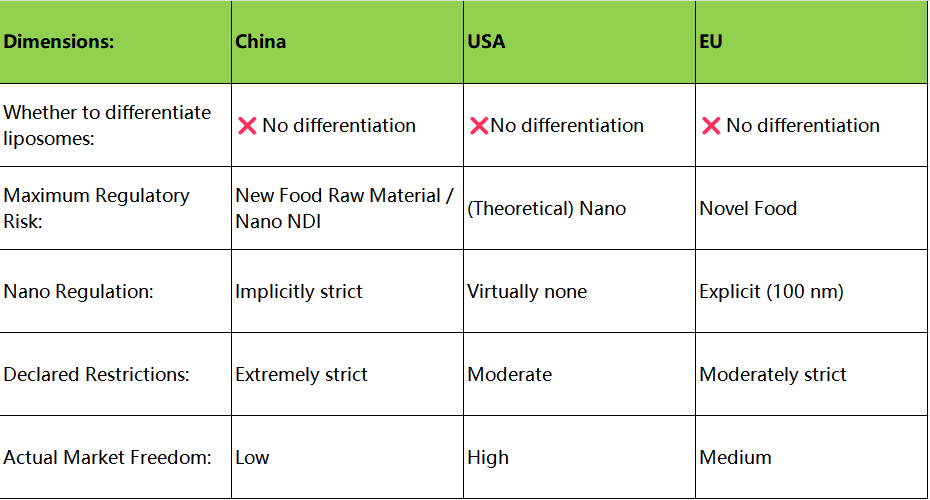
Regulation of Nanomaterials (Real Risk Point):
EFSA Definition:
0–100 nm = Nanomaterials
100 nm = Non-nanomaterials
Impact:
<100 nm may be approved as Novel Food / Nanofood
>100 nm is generally used as a regular supplement
This is why many manufacturers label:
100–250 nm (deliberately circumventing regulations)
Differences Among Member States (Real-world Issues):
Germany, France: Stricter
Eastern Europe: Relatively lenient
The same product may require Registration. Or additional data may be required in different countries.
Labeling Transparency: EU labels must clearly state the nutrient source and the presence of any allergens (e.g., phospholipids derived from soy).
3. China Market: Blue Hat Registration vs. CBEC
China represents a massive opportunity but features a unique "dual-track" regulatory system managed by the SAMR (State Administration for Market Regulation).
General Trade & Blue Hat: To sell in physical pharmacies or general retail, the product must obtain the "Blue Hat" (Health Food) registration or filing. This process is time-consuming and requires strict adherence to the National Food Safety Standards (GB Standards) regarding both active ingredients and excipients.
Cross-Border E-Commerce (CBEC): This is the "fast track" for international brands. By selling through platforms like Tmall Global or JD Worldwide, products can often follow the regulations of their origin country (e.g., US FDA) with simplified Chinese labeling.
Regulatory Focus: China has strict limits on the daily dosage of Vitamin C in health foods. Ensuring your high-potency liposomal formula stays within these limits is crucial for successful entry.
Key Takeaways:
Across all three markets, liposomal vitamin C is not automatically recognized as “superior”—regulatory authorities focus on ingredient safety, accurate labeling, and substantiation of claims.
Particle size, encapsulation efficiency, and consistent manufacturing quality are critical—not just for product performance, but for regulatory compliance.
Health claims must always be qualified, supported by evidence, and accompanied by mandatory disclaimers (where applicable).
4. Ready to Move Forward?
Option 1: Build Your Product Today
Don't let regulatory uncertainty stall your global expansion. Get in touch with us to design liposomal products that are both scientifically robust and market-compliant. "Our Biotechnology for Your Strategic Vantage."
Option 2: Identify Real Liposomal Vitamin C
Is Your Raw Material Truly Liposomal? Compliance on labels must be backed by reality in the lab. In a market flooded with "dry blends" claiming to be liposomal, how do you verify the physical integrity of your ingredients?
➡️ Read Our More Articles about Market Trends & Ingredients
FAQ (Global Regulatory & Labeling)
❓ Is liposomal vitamin C regulated as a separate ingredient in the USA, EU, or China?
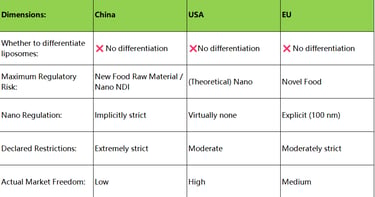
A: As of April 2026, liposomal vitamin C is not regulated as a separate ingredient category in the United States, the European Union, or China. It is typically managed as ordinary vitamin C in terms of regulatory approach.
❓ What are the key FDA compliance requirements for liposomal vitamin C in the USA?
A: In the USA, liposomal vitamin C is regulated under DSHEA. Key requirements include using GRAS-status ingredients where possible, making only Structure-Function Claims (no disease claims), including the mandatory FDA disclaimer, and possessing analytical data (e.g., particle size, encapsulation efficiency) to prove liposomal integrity if labeled as such.
❓ Do I need to file an NDI notification for liposomal vitamin C in the USA?
A: It depends. If your formulation uses a unique phospholipid carrier, it may require an NDI notification. Most brands opt for ingredients with GRAS status to expedite market entry and avoid the NDI process.
❓ What kind of claims can I make for liposomal vitamin C in the USA?
A: You cannot claim it "cures" or "prevents" any disease. You may use Structure-Function Claims (e.g., "Supports healthy immune function and cellular antioxidant defense"), which must be accompanied by the standard FDA disclaimer: "This statement has not been evaluated by the FDA..."
❓ Is liposomal vitamin C considered a Novel Food in the EU?
A: It may be. Under EU Regulation 2015/2283, if your manufacturing process significantly alters the composition or structure of the vitamin C, it might be classified as a Novel Food, requiring a rigorous safety assessment and authorization before sale.
❓ What is the EU’s stance on nanomaterials in liposomal vitamin C?
A: The EFSA defines materials 0–100 nm as nanomaterials. Products <100 nm may be approved as Novel Food/Nanofood, while >100 nm is generally used as a regular supplement. Many manufacturers target 100–250 nm to avoid nanomaterial regulations.
❓ Do EU member states have the same regulations for liposomal vitamin C?
A: Not exactly. While the EU has overarching rules, implementation can vary. Countries like Germany and France may be stricter, while some Eastern European countries may be relatively lenient. The same product may require registration or additional data in different countries.
❓ What are the main ways to launch liposomal vitamin C in China?
A: China has a dual-track system. For general trade (physical pharmacies/retail), you typically need "Blue Hat" registration or filing, which is time-consuming. For faster entry, many brands use Cross-Border E-Commerce (CBEC) platforms like Tmall Global, where products may follow origin-country regulations with simplified Chinese labeling.
❓ Are there dosage limits for liposomal vitamin C in China?
A: Yes. China has strict limits on the daily dosage of vitamin C in health foods. Ensuring your high-potency liposomal formula stays within these limits is crucial for successful market entry.
❓ What are the most important factors for global liposomal vitamin C compliance?
A: Across all markets, key factors include ingredient safety, accurate labeling, substantiation of all claims, controlled particle size, verified encapsulation efficiency, and consistent batch-to-batch manufacturing quality.